In August, eight clay vessels that had spent 123 years in museums in New York and California came back to the Pueblo of Pojoaque. They are the center of a new exhibition at the Poeh Cultural Center & Museum on Cities of Gold Road. The museum holding them is closed every Saturday and Sunday.
The biggest public weekend on the Poeh's fall calendar happens at a different address. That's the Pathways Winter Market, November 21 and 22 at Buffalo Thunder Resort & Casino. So the Poeh's fall needs two trips. One is a weekday stop for the pottery that left in 1903. The other is a weekend at a free market where Indigenous artists sell their own work.
A photograph with twelve pots in it
In 1903, someone photographed Antonio Tapia Montoya, then governor of Pojoaque Pueblo, with tribal members, the anthropologist and collector George H. Pepper, and 12 clay pots Pepper had collected from the pueblo. New Mexico Magazine described the photo in its October 15 preview of the exhibition. A 2016 Santa Fe Reporter story dated the photo to July 25, 1903. It said Pepper had been sent by the American Museum of Natural History in New York and that the pottery was legally purchased. That article also described the pressures of the era, when tourist demand, drought and economic recession made pottery sales appealing.
Over the following decades, the pueblo community tracked down some of the pieces. Several were at the American Museum of Natural History, and others were at the Phoebe A. Hearst Museum of Anthropology in Berkeley, California, New Mexico Magazine reported. Eight of the 12 have now come home. Where the other four are is still unknown.
Four and four, on the same day
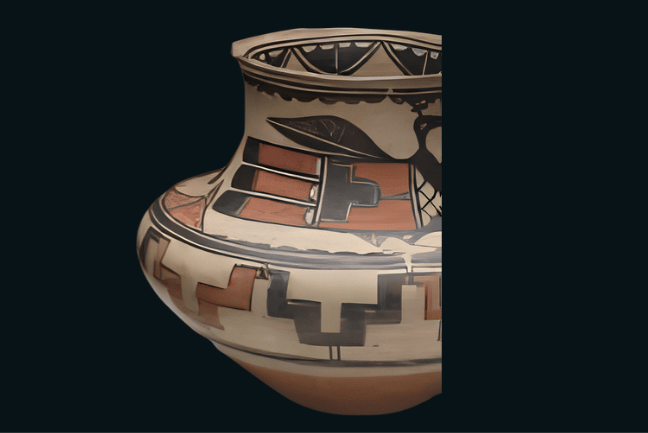
The Poeh Cultural Center says the eight vessels arrived back at the Pueblo on August 22, 2026, by two routes. Four were repatriated from the University of California, Berkeley. The other four came from the American Museum of Natural History in what the Poeh calls an "ethical return." All eight were shipped together to the center.
The exhibition built around them is called "Gi Kay: Nambí Ówingeh Gi Weh Pówá," translated as "Resilience: We Are Home." It was scheduled to open October 16 at 10 a.m. with food, traditional dancing and demonstrations. The Poeh's own exhibition page describes the vessels as having left "more than 120 years" ago and having spent generations in museum collections.
This is the third time in ten years the Poeh has brought pottery back to the pueblo, and each time the arrangement has gone further:
- 2016. "In T'owa Vi Sae'we," or The People's Pottery, put nine Pojoaque-made ceramics on display as a long-term loan from the Smithsonian, according to the Santa Fe Reporter.
- 2019. "Di Wae Powa" brought 100 pots from six Tewa pueblos to the Poeh as a long-term Smithsonian loan after several years of negotiation and community visits, New Mexico Magazine reported. It opened October 12, 2019.
- 2026. The eight vessels in "Gi Kay" came back by repatriation and ethical return. They were not loaned.
The 2016 loan already pointed this way. Karl Duncan, then the Poeh's executive director, described to the Santa Fe Reporter what a homecoming would look like:
"When the pots come back, prayers will be said and they'll pretty much be welcomed home."
He said that about borrowed pieces ten years ago. This fall's eight pots are not on loan.
The museum keeps weekday hours
The Poeh Museum is at 78 Cities of Gold Road in the Poeh Center complex, about 15 miles north of Santa Fe on US 84/285. It is open Monday through Friday from 10 a.m. to 5 p.m. It is closed on Saturdays, Sundays, national holidays and tribal holidays, and the center asks visitors to call (505) 455-5041 to confirm hours before coming.
Admission category | Price |
|---|---|
General | $10 |
Seniors 60+ | $7 |
Military | $7 |
Students with ID | $7 |
Kids 12 and under | Free |
Native American visitors | Free |
A visit also includes two rotating galleries, a permanent pueblo history exhibition, outdoor sculptures and a theater space. The permanent exhibit, Nah Poeh Meng, is a 1,600-square-foot installation that tells Pueblo history from a Tewa perspective in seven languages. That history gives context to the 1903 photo and what came after it. Seeing it before "Gi Kay" helps.
The Poeh is also still teaching. Its Fall 2026 Poeh Arts program offered micaceous pottery, belt weaving, jewelry, sewing and Pueblo men's kilt embroidery. The classes are free to Native American adults with tribal ID, and fall registration is now closed.
On November 21, the season moves to Buffalo Thunder
The Pathways Winter Market runs Saturday, November 21, from 9 a.m. to 5 p.m. and Sunday, November 22, from 9 a.m. to 4 p.m. at Buffalo Thunder Resort & Casino, 30 Buffalo Thunder Trail. Admission is free. The Poeh bills it as the largest two-day holiday art market in New Mexico.
This year's market has room for more than 250 Indigenous artists in indoor, carpeted 10-by-10-foot booths. Artist booths are full and only a waitlist remains. Shoppers can expect jewelry, pottery, paintings, textiles, traditional clothing and holiday décor, along with traditional arts demonstrations and Indigenous food trucks and tents. For the 2025 market, the Poeh said both admission and parking were free.
Here the two halves of the season connect. The 1903 pots left the pueblo through a sale to a collector working for a New York museum. The Winter Market is also a sale, but the Poeh organizes it and Indigenous artists sell their own work from their own booths. The vessels in "Gi Kay" and the pottery on the Buffalo Thunder tables come from the same tradition, and you can see both within a few days of each other.
The market has run every November for at least five years. The Poeh's own event archive shows when each recent edition ran:
Year | Market dates |
|---|---|
2022 | Nov. 26–27 |
2023 | Nov. 25–26 |
2024 | Nov. 23–24 |
2025 | Nov. 22–23 |
2026 | Nov. 21–22 |
The Winter Market is separate from the Poeh's summer Pathways Indigenous Arts Festival, which held its sixth annual edition August 14 through 16 this year.
Putting the season on one calendar
From publish day through mid-December, here is how the Poeh's season fits together:
- Any weekday from now on, 10 a.m. to 5 p.m.: "Gi Kay" and Nah Poeh Meng at the Poeh Museum, 78 Cities of Gold Road. Call (505) 455-5041 first, especially in holiday weeks, because the museum closes for national and tribal holidays.
- Saturday, November 21, and Sunday, November 22: Pathways Winter Market at Buffalo Thunder, with free admission. Saturday has an extra hour in the afternoon.
- Friday, December 11, and Saturday, December 12: Pojoaque's Our Lady of Guadalupe Feast Day. New Mexico Tourism lists Vespers, a procession and dances at 6 p.m. on December 11, and Mass at 10 a.m. followed by dances on December 12. The New Mexico Indian Affairs Department calendar also lists December 12. Both sources say dates can change and recommend contacting the Pueblo before you go.
If you're hosting guests over Thanksgiving week, keep in mind that the museum is closed Saturday and Sunday and the market closes at 4 p.m. on Sunday. If they're arriving late in the week, plan their museum stop for a weekday.
At Origins Realty Group, the Pojoaque Valley is home ground for us, and we like hearing how neighbors spend these weekday mornings and holiday weekends. If you're thinking about life north of Santa Fe, or a move within the valley, connect with a Santa Fe real estate expert who knows where Cities of Gold Road goes and what's open when.