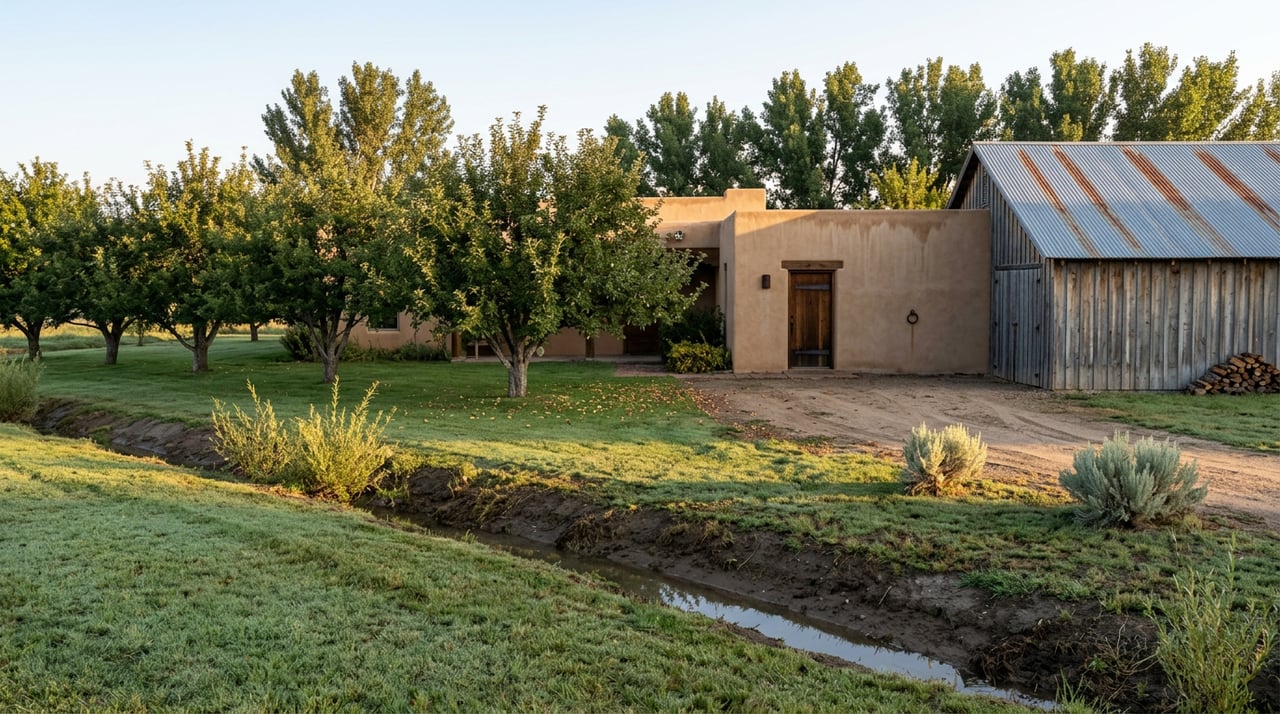
Corrales protects one road on purpose. There is no stoplight-lined bypass through the orchards, no turn lane carved into the acequia banks, no sidewalk grid stitching one end of the village to the other. That absence is not an oversight. It is what keeps roosters audible over traffic noise and lets irrigation ditches run past front yards instead of into storm drains. Then, for one weekend every September, the village invites more people down that same road than actually live behind it.
On September 26 and 27, 2026, the Kiwanis Club of Corrales Foundation runs the Corrales Harvest Festival, a two-day event that has been held every fall since 1985. According to the festival's own count, it now draws over 10,000 visitors across those two days, up from roughly 800 attendees at the first hayride-only gathering. Corrales itself is home to a little over 8,500 residents. For one weekend, more people pass through the village than actually live there year-round, and the entire logistics of the festival exist because of that math, not despite it.
A Village That Grew a Festival Instead of Itself
The gap between those two numbers is the story. Corrales has spent decades holding its population roughly flat through large-lot zoning and a deliberate resistance to subdivision-style growth, the same policy choices that keep the village's roads narrow and its lot lines generous. The festival, meanwhile, grew from a few hundred neighbors on hay wagons to a regional draw that multiplied more than twelvefold as farms, restaurants, and local businesses signed on. A village that intentionally didn't get bigger ended up hosting an event that did.
That mismatch is exactly why the festival looks the way it does on the ground. You cannot park a small city's worth of cars on roads designed for tractors and horse trailers, so the organizers didn't try. They built something else instead.
Why the Village Needed Its Own Transit System
The festival's answer to the parking problem is a fleet of tractor-drawn hay wagons the organizers call the "Corrales Not-So-Rapid-Transit." Riders need a wristband, available at any admission tent, and the wagons run a fixed route from the Village Mercantile store all the way to the Old Church and Casa San Ysidro. Designated parking areas sit a short distance from the tractor stops rather than at the festival grounds themselves, with lots like the one at Corrales Elementary on Target Road absorbing overflow so cars never compete directly with festival foot traffic on the narrow through streets.
It is a solution that fits the village's character even as it solves a genuinely urban logistics problem. Instead of shuttle buses, Corrales moves 10,000 people on the same equipment it uses to move hay. The fix looks rural because the constraint is rural: one road, no bypass, and a community that has no intention of building one just to make a single weekend easier.
Where the Wagons Actually Stop
The stops themselves are spread across the village rather than clustered at a single fairground, which is part of why the tractor route matters more here than it would at a festival with one central gate. Riders and walkers move between:
- La Entrada Park, home to the Harvest Festival Art Show, a tradition running more than 20 years, tucked into the shade behind the library
- The Village Government Office Complex across from La Entrada Park, which turns into a marketplace of business and nonprofit booths, food trucks, and a model train display
- The Corrales Rec Center, hosting live music on the main stage for the full two days
- The Old Church at 966 Old Church Road and neighboring Casa San Ysidro, where the Corrales Historical Society runs its Heart of Corrales Fiesta, complete with the long-running Pie Walk and a look inside one of the more complete collections of historic New Mexican furnishings anywhere in the state
- Frontier Market, offering New Mexico wine tastings and giveaways through the weekend
- The Old School House at 3650 Corrales Road, across from Frontier Market, which turns its lawn into a scarecrow garden while neighboring shops Belle's Urban Deli, Desert Bird Mercantile and Furniture Gallery, and The Refillery stay open for foot traffic
- Ex Novo Brewing Co. and Hollow Spirits Nickel Co., both regular stops along the route for anyone who wants a drink between wagon rides
Walking the whole span end to end is a real distance in a village with no continuous sidewalk, which is the practical reason the wagons exist at all. Locals who know the route tend to pick two or three stops and let the tractor handle the rest.
The Horses Still Have the Right of Way
Even at 10,000 visitors, Corrales doesn't stop being an equestrian village for the weekend. CHAMP, the Corrales Horse and Mule People, runs horse events during the festival, including the Ditch Pony Promenade down the village's ditch roads. It's a fitting detail given how the village treats its trails the rest of the year. Along the Corrales Bosque Preserve, a 662.4-acre stretch of cottonwood forest running the length of the village on the west side of the Rio Grande, the posted rule is that bikers yield to equestrians and walkers yield to equestrians too. Horses have the primary right of way on every trail in the preserve, festival weekend included.
That preserve is also worth knowing about this particular fall for a reason that has nothing to do with the festival. Earlier in 2026, the Middle Rio Grande Conservancy District closed a 100-acre section of the bosque for a month-long invasive species and fuels-reduction project done in partnership with the state forestry division, running from February 4 through February 28. The closure is long over and the trails are back to normal use, which means anyone who wants a quiet counterpoint to the crowds on Corrales Road this September has a genuine option two blocks off the festival route.
The festival adds one more small tradition to track if you're the type who follows village trivia: nominations are open for the next Pet Mayor of Corrales, voted on by residents during the weekend, a title that has become as much a part of the festival's identity as the hay wagons themselves.
Planning Around the One Weekend the Road Doesn't Work Like Usual
For residents who already know the rhythm, the festival is easiest to enjoy once you stop expecting Corrales Road to function the way it does every other Saturday. A few things worth having settled before September 26:
- Traffic through the village is restricted both days, so a normal drive-through commute is not realistic during festival hours
- Wagon rides require a wristband purchased at any admission tent, not at the wagon itself
- Parking is intentionally scattered near tractor stops rather than centralized at any one venue
- The bosque trails are a legitimate quiet alternative this year, fully reopened since the February closure
None of this makes Corrales bigger. It makes the one weekend it briefly acts bigger a little easier to move through, provided you plan around the same road that keeps the rest of the year so quiet.
If you're the kind of person who already has opinions about the best tractor stop or the fastest way from the Old Church to the brewery, you already understand what makes this village different from the subdivisions filling in around it. If you're weighing whether that difference is worth building a life around, the team at Origins Realty Group has spent years watching how a single road, a working bosque, and one enormous weekend shape what a Corrales address actually means. Connect with a Santa Fe real estate expert when you're ready to talk specifics.