If you’re considering a home in Corrales, the usual city-utility checklist may not tell you much. In this market, questions about water, wastewater, and irrigation are often tied to permits, property layout, and recorded rights, not just whether a service is “on.” The good news is that once you know what to ask, you can evaluate a Corrales property with much more confidence. Let’s dive in.
Why Corrales Works Differently
Corrales is a utility-light market, which means many homes operate differently from properties connected to typical municipal systems. The Village’s planning documents state that Corrales does not currently supply residential, commercial, industrial, or agricultural water.
Instead, homes in Corrales are generally self-supplied by domestic wells, and wastewater is usually handled through septic systems. The Corrales Road STEP line collects effluent from septic tanks for discharge to the ABCWUA system, but that is not the same as a standard residential sewer setup.
Irrigation is a separate layer altogether. In Corrales, ditch and acequia irrigation is tied to the Middle Rio Grande Conservancy District, not to a home’s domestic water supply.
Domestic Wells in Corrales Homes
For many Corrales buyers, the well is one of the first systems to review. Under New Mexico guidance, a domestic well can be used for household needs, watering domesticated animals, and irrigating non-commercial lawn, garden, trees, or landscaping up to one acre.
Before a well is drilled, the owner needs a permit from the State Engineer. The well must be drilled by a licensed well driller, and the driller is expected to file a Well Record after the work is complete.
What buyers should verify
When you review a Corrales property, ask for key well documents early in the process. This helps you confirm both the physical system and the paper trail.
- Current well permit status
- Whether the permit is in the seller’s name
- Driller’s log or Well Record
- Recent water test results
- Pump service or maintenance history
These questions matter because Corrales households rely on OSE-permitted domestic wells, and the Village’s long-range planning notes groundwater quality as an active concern in an area with many septic systems.
What a well review can reveal
A well review is not only about whether water comes out of the tap. It can also reveal whether records are complete, whether the pump has been maintained, and whether there are signs the system may need closer review.
If the permit history, well ownership, or pump details are unclear, it may be wise to bring in a licensed well driller or another qualified water professional before closing.
Septic Systems Are Standard in Corrales
In Corrales, septic is usually the rule rather than the exception. That means buyers should treat the septic system as a major part of due diligence, especially on rural or acreage properties.
New Mexico rules state that no one may install or modify an onsite liquid waste system without a permit first. In general, that work must be completed by a properly licensed CID contractor, although there is a limited homeowner exception for certain permitted septic tanks and conventional trench or bed disposal fields.
Septic records to request
Do not rely only on an online permit lookup. NMED’s permit finder notes that the online information is only valid through January 27, 2017, and advises buyers to contact the local field office with property documentation.
That is why it is smart to request the full septic file from the seller when possible. Helpful records include:
- Septic permit
- As-built information
- Pumping history
- Recent inspection report
- Any maintenance or repair records
If those records are incomplete, outdated, or unavailable, you may want a septic engineer or NMED-approved technician involved before you move forward.
Lot layout matters with septic
In Corrales, septic feasibility is not just about the age of the tank. It can also depend on lot shape, nearby drainage features, groundwater depth, and required setbacks.
New Mexico setback rules require minimum distances between septic components and private wells. They also set larger separations for drain fields, seepage pits, canals, drainage ditches, arroyos, and other watercourses. Conventional systems also need four feet of suitable soil beneath the absorption area.
Key Well and Septic Setbacks
You do not need to memorize every measurement, but a few numbers help explain why some lots are more complex than they first appear.
- Private well to treatment unit: 50 feet
- Private well to drain field or seepage pit: 100 feet
- Lined canals: 10 feet
- Unlined canals, drainage ditches, and arroyos: 15 to 25 feet
- Other watercourses: 50 to 100 feet
On a rural property, these distances can influence where additions, replacement systems, or site improvements may be possible.
Irrigation Is a Separate System
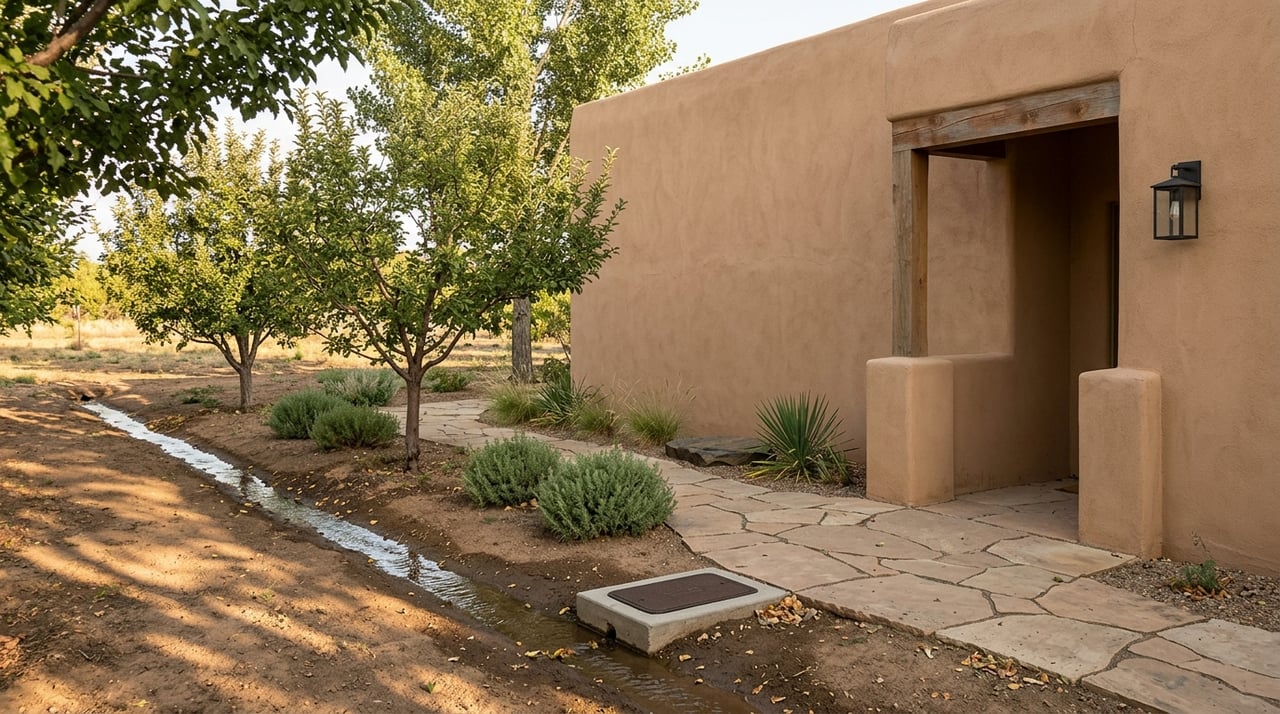
One of the most important things to understand about Corrales is that irrigation is separate from your household water source. The Middle Rio Grande Conservancy District operates and maintains irrigation, drainage, and flood-control systems throughout the valley, and Corrales planning documents state that MRGCD owns and maintains the ditches and drains in Corrales.
That means ditch water is not the same as municipal service, and it should not be treated like a guaranteed utility line. It is part of a seasonal, rights-based system.
What that means for buyers
MRGCD operational updates show that irrigation deliveries can be limited, shifted, or suspended when river flows are insufficient. Rainfall can also create only short windows for some deliveries.
For you as a buyer, that means a property with ditch access may still require detailed follow-up. If irrigation matters to your plans, confirm how the system works for that specific parcel rather than assuming access tells the whole story.
Irrigation questions worth asking
If a property depends on ditch water, ask direct questions about access and history. These details can affect both use and long-term planning.
- Who is the ditch rider?
- Is there a recorded easement or turnout?
- Who maintains the ditch?
- Is there a historic or current irrigation right attached to the parcel?
Corrales Planning and Zoning also states that the village does not handle disputes involving private easements, private roads, water rights, or private agreements. In practical terms, that means some irrigation questions may need title review or legal review rather than a simple permit check.
Why Corrales Due Diligence Takes More Care
For many buyers, the adjustment is mental as much as practical. In a more urban setting, you may be used to checking whether a property is connected to city water and sewer. In Corrales, utility questions often become title, permit, and site-planning questions instead.
That does not make a property better or worse. It simply means each home can be more site-specific, and the details deserve careful review before closing.
A practical buyer checklist
If you are comparing Corrales homes, ask for these items as early as possible:
- Water source and permit status
- Well record and recent water test
- Septic permit and as-built information
- Pumping history and inspection reports
- Any recorded irrigation easement, ditch-right, or water-right document
When these records line up clearly with the property and the existing improvements, you can move ahead with better information and fewer surprises.
When to Bring in Specialists
Some properties are straightforward, and some need a deeper review. Knowing when to pause and get expert input can save time, money, and stress.
Consider bringing in a licensed well driller or another qualified water professional if well yield, pump details, permit history, or permit ownership are unclear. Consider a septic engineer or NMED-approved technician if the system is older, records are missing, or the lot is close to wells or drainage features.
If ditch access, an easement, or irrigation ownership is not obvious, a water-rights or real estate attorney may be appropriate. Since Corrales does not resolve private disputes over easements or water rights, those issues often need private review.
If you are buying in Corrales from out of town, this extra diligence can feel unfamiliar at first. But with the right questions and the right local guidance, you can sort through the details and make a confident decision.
If you’re exploring Corrales homes and want steady guidance on rural property details, custom considerations, and the questions that matter before you close, connect with Origins Realty Group.
FAQs
What water source do most Corrales homes use?
- Most Corrales homes are self-supplied by domestic wells rather than a municipal residential water system.
What can a domestic well in New Mexico generally cover?
- State guidance says a domestic well can generally cover household use, watering domesticated animals, and irrigation of non-commercial lawn, garden, trees, or landscaping up to one acre.
What septic records should a Corrales homebuyer request?
- Ask for the septic permit, as-built information, pumping history, recent inspection reports, and any maintenance or repair records.
What should a Corrales buyer ask about a private well?
- Ask about permit status, whether the permit is in the seller’s name, the driller’s log or Well Record, recent water testing, and pump service history.
Is irrigation water in Corrales the same as domestic water service?
- No. Irrigation is separate from household water and is tied to the Middle Rio Grande Conservancy District’s ditch and acequia system.
Why can irrigation access in Corrales be more complex than it looks?
- Ditch water is part of a seasonal, rights-based system, and buyers may need to confirm easements, turnout access, maintenance responsibilities, and any irrigation right tied to the parcel.
Why do setbacks matter for Corrales wells and septic systems?
- Setbacks can affect where septic components and wells may be located, and on rural lots they may also limit future improvements or replacement options.
When should a Corrales homebuyer bring in a specialist?
- Bring in a specialist when well records are unclear, septic files are incomplete, the lot is close to drainage features, or ditch access and irrigation rights are not clearly documented.